
VO₂max Explained: The Number That Predicts Performance and Long-Term Health
If you care about performance, heart health, metabolic function, or longevity, VO₂max is the metric to track.
VO₂max has been studied for 100+ years now. When it started they used these large cumbersome bags to collect and measure expired gas after test subjects ran around a track. Since the pioneers Hill & Lupton did not have previous studies to work with they spent hours creating formulas.
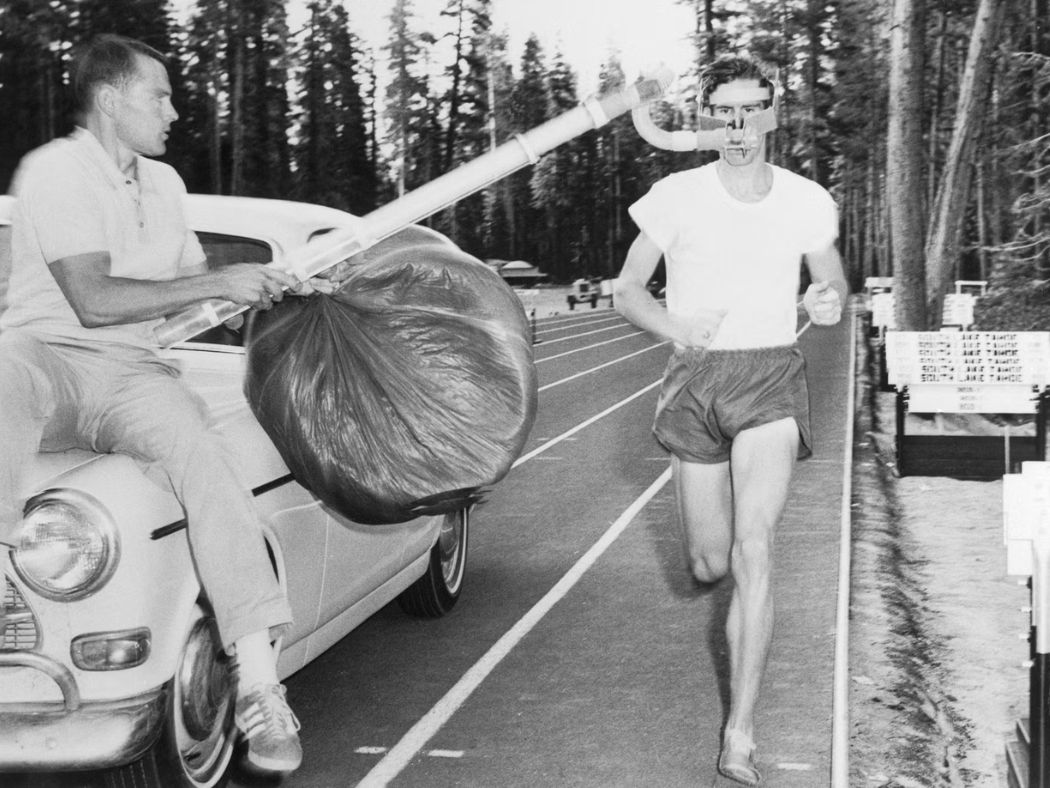
Flash forward to our modern era where VO₂max is one of the most talked-about fitness metrics in health & wellness, endurance sports, wearable tech, and longevity podcasts. But even with technological advancements there is still confusion on what it means exactly and what influence it has on your training, fitness level, and disease risk.
The truth is: VO₂max isn’t just for elite runners or cyclists. It’s one of the strongest indicators we have for how well your body produces energy, delivers oxygen, and supports long-term health.
Recently I had the opportunity to have my VO₂max professionally tested (which hasn’t happened since PT school over 10 years ago) and I’d love to share my insights as well as what the current research has to say about this unique metric.
First let’s break down what VO₂max actually means on a physiological level.
In simple terms VO₂max = the maximum volume of oxygen your body can consume.
More specifically it is the maximum oxygen you can consume while exerting yourself at very high effort.
Imagine if you were running uphill at full speed. After a certain point, you will feel so out of breath that you couldn’t possibly get any more air in or out of your lungs. During this uphill run you are sure to hit your VO₂max which will ultimately act as a barrier and will make you have to slow down.
A good analogy to understanding your VO₂max is to think of it like your body’s engine size. While engine size alone does not necessarily mean you are more efficient, faster, or going to win the race–it can help you understand how metabolically fit you are for your age, weight, and gender.
If you consider the entire process of how your body converts energy, VO₂max is a very useful metric since it reflects how well your body can:
- Pull oxygen into the lungs
- Transfer it into the bloodstream
- Pump it via the heart
- Deliver it to working muscles
- Use it inside cells (mitochondria) to produce energy
This makes it a full-body performance metric helping older adults understand why they get out of breath walking up the stairs, and the active athlete looking to drop seconds off their race times.
So why should you care about your specific VO₂max?
This is where it gets interesting since it is not just about running faster. Across many large populations, VO₂max has shown to be a strong predictor of all cause-mortality and cardiovascular events.
1. Cardiovascular Function & Disease Risk
In a 2024 edition of the British Journal of Sports Medicine researchers did a large overview examining 199 unique cohort studies, representing over 20.9 million observations and found that higher cardiorespiratory fitness (often represented by VO₂max or closely related metrics) is consistently linked with lower risk of all-cause mortality and disease outcomes.1
2. Metabolic Efficiency
In 2020, a retrospective study found that lower VO₂peak (a value similar to VO₂max) was strongly associated with higher likelihood of metabolic syndrome — a cluster of risk factors including high blood sugar, high blood pressure, abdominal obesity, and dyslipidemia.2
This supports the idea that lower VO₂max is linked with poorer overall metabolic health, not just poor aerobic performance.
3. Long-term Function & Aging Outcomes
In a long-term observational study of 4,137 U.S. adults followed for over 24 years, higher VO₂max measured via cardiopulmonary exercise testing was strongly associated with lower risk of all-cause mortality, cardiovascular mortality, and cancer mortality. Each increase in VO₂max was tied to substantial reductions in risk even after adjusting for age and other risk factors, an important aging outcome.3
Want to Improve Your VO₂max?
Here’s the most effective way to do it.
1. Zone 2 Training
For clarification Zone 2 or “Heart Rate Zone 2” relates to 60-70% of your VO₂max and is characterized by exercise at an intensity where fat is the primary fuel source. It’s actually the highest intensity you can maintain while the body burns fat under an aerobic workload.
Zone 2 is essentially the base builder or aerobic training that is steady, moderate, but an effort where you can still speak in full sentences. If you use a watch for your training you will often be in this zone when warming up and cooling down.

Zone 2 has been highly popularized in our modern era as current VO₂ training aims to optimize the whole spectrum of exercise intensities, not just the “max”. This rise in Zone 2 training recognizes that precise, individualized training zones are essential for fitness development.
Zone 2 Training can:
- Increase mitochondrial density
- Improve fat oxidation
- Strengthen the aerobic system
- Build durability and recovery capacity
This benefits you by:
- Giving you better endurance
- Allowing you to recover better
- Allowing you to have better training consistency
- Creating a stronger foundation which is crucial for more training stress, effort, and overall workload
2. Interval Training
Interval training are workouts designed to push oxygen demand high enough to force adaptation.The main purpose of this type of workout is to provide a direct stimulus to maximize your aerobic power thus making you reach and sustain time at your VO₂max.
Since it can take approximately 2 minutes for your body to reach your VO₂max from resting it is recommended to train at your VO₂max for 3-5minutes at a time.
Some common interval workouts may look like this:
- 5 x 3 minutes with 2-3 minutes to recover
It is important to note that good interval training takes into account the appropriate rest periods. Especially for endurance athletes who are looking to spend quality time improving their VO₂max we do not want to spend too long in recovery as it will take the body longer to ramp back up towards their VO₂max on the next interval.
Interval Training benefits you by:
- Increasing your stroke volume or the amount of blood you can pump from your heart with each heart beat
- Better oxygen delivery by increasing the amount of blood that is pumped and distributed
- Improving your max aerobic power making you faster
- Increasing your fitness gains with less time required
The bottom line…what improvements in VO₂max actually do for you:
For athletes
- Faster race times
- Stronger finishing kicks
- Better ability to hold pace under fatigue
- Faster recovery between hard sessions
- More resilience across training blocks
For average adults
- More energy day to day
- Less breathlessness with stairs or hills
- Better blood pressure and cardiovascular function
- Better metabolic health and glucose control
- Higher capacity for hobbies and active life
For longevity
- Better ability to handle physical stress
- Lower risk of chronic disease
- Better functional independence with age
- Higher “healthspan” — not just lifespan. Or better put, more meaningful later years in life filled with independence.
A few takeaways that I learned about my own VO₂max test.
If you want to understand your fitness with more clarity than a wearable technology estimate, testing can be incredibly valuable.
A true VO₂max test can help you:
- Identify accurate heart rate zones
- Crystal clear zones can help you understand your unique training zones better than the 220-age formula can
- Crystal clear zones can help you understand your unique training zones better than the 220-age formula can
- Understand your strong suits when it comes to endurance training
- When you know the point at which you switch from aerobic to anaerobic workload you can target workouts to be more purposeful
- When you know the point at which you switch from aerobic to anaerobic workload you can target workouts to be more purposeful
- Clarify when you’re burning fat versus carbohydrates.
- This is highly useful for those looking to lose weight and those needing fueling strategies for long endurance events.
- This is highly useful for those looking to lose weight and those needing fueling strategies for long endurance events.
- Train with better precision and less guesswork around individual training days
- Calories burned in specific ranges can be a helpful way to ensure you’re eating properly and getting in the right amount of fuel to sustain your training
.jpg)
At the end of the day, it’s not about comparing yourself to others.
For many people, the biggest benefit isn’t how your number stacks up against some arbitrary age and gender chart. It’s the ability to learn how your body is able to work and ultimately be able to train longer and smarter. You will also feel confident you’re working in the right effort level depending on your goals.
VO₂max is one of the best indicators of how well your body can produce energy, handle physical stress, and support long-term health.
You don’t need to be an elite athlete to benefit from it. You just need to understand it so you can train in a more balanced way.
If you care about performance, heart health, metabolic function, or longevity, VO₂max deserves a spot in your training conversation.
References:
- Cardiorespiratory fitness is a strong and consistent predictor of morbidity and mortality among adults: an overview of meta-analyses representing over 20.9 million observations from 199 unique cohort studies. Br J Sports Med. 2024 May 2;58(10):556-566. https://pubmed.ncbi.nlm.nih.gov/38599681/
- Cardiorespiratory fitness is strongly linked to metabolic syndrome among physical fitness components: a retrospective cross-sectional study. J of Phys. Anthro. 01 October 2020, Vol 39, Article 30. https://link.springer.com/article/10.1186/s40101-020-00241-x?
- The Relationship Between Exercise and Longevity: Challenging the U-Shaped Hypothesis. American College of Cardio. Jul 08, 2025. https://www.acc.org/Latest-in-Cardiology/Articles/2025/07/02/15/19/The-Relationship-Between-Exercise-and-Longevity?
...